
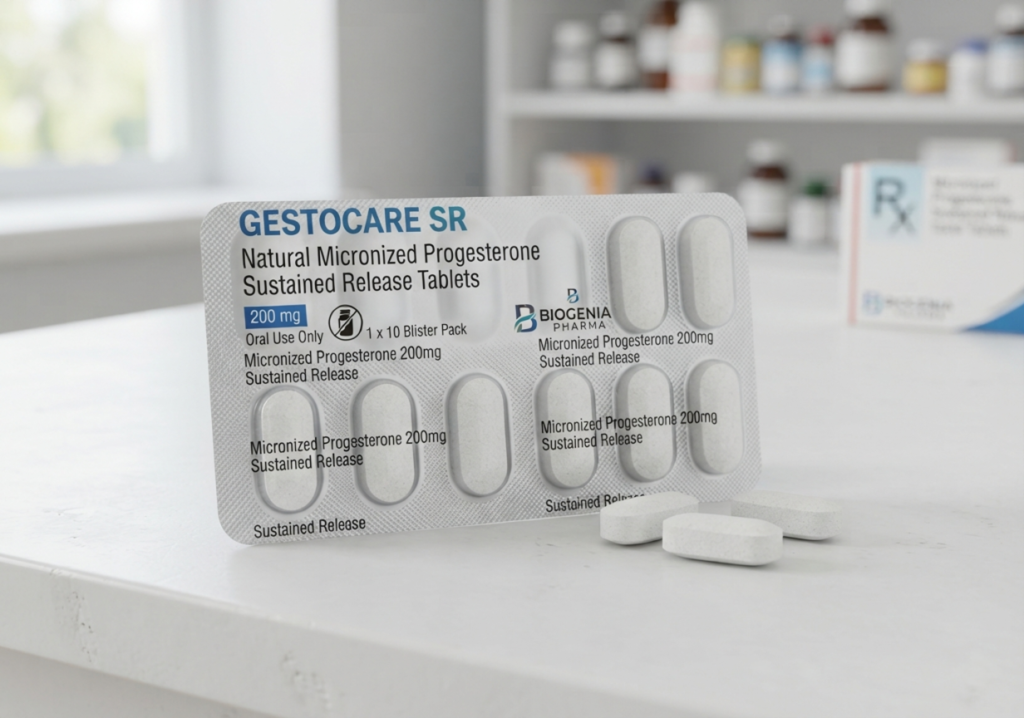
Natural Micronized Progesterone Sustained Release Tablets
Natural micronized progesterone sustained release (SR) tablets contain progesterone that is chemically identical to the hormone your ovaries make, ground to particles under about 10 micrometres (micronized) so it dissolves and absorbs well by mouth, and pressed into a matrix that releases it slowly over hours (sustained release). The micronization solves progesterone's absorption problem; the SR matrix flattens the blood-level peak, which is what allows once-daily dosing and reduces the drowsiness that conventional micronized capsules are known for. They are prescribed in strengths of 100, 200, 300 and 400 mg, most often for luteal support, threatened or recurrent miscarriage, irregular or absent periods, and endometrial protection during estrogen therapy.
What “natural”, “micronized” and “sustained release” each actually mean
The product name is three separate claims stacked together, and each one solves a different problem. Most pages treat them as marketing words. They are not — each maps to a specific pharmaceutical decision.
| Term | What it means | The problem it solves |
|---|---|---|
| Natural (bioidentical) | The molecule is progesterone itself — the same C21 steroid your corpus luteum secretes. It is semi-synthesised in a factory (usually from diosgenin in yam or soy), so “natural” describes the structure, not the origin. | Synthetic progestins (dydrogesterone, medroxyprogesterone acetate, norethisterone) are structurally different and carry extra androgenic or glucocorticoid activity. Identical structure means identical receptor behaviour. |
| Micronized | Particle size reduced to roughly under 10 µm, which multiplies the surface area available to dissolve. | Un-micronized oral progesterone is absorbed poorly and unpredictably — it barely works by mouth. Micronization is what made an oral tablet viable at all. |
| Sustained release | A polymer or wax matrix that lets the drug leach out over hours instead of dumping it in the first 30 minutes. | Conventional micronized progesterone peaks fast and falls fast. That sharp peak drives the sedation, and the fast fall forces twice- or three-times-daily dosing. |
Why micronization alone was not enough
Even after micronization, swallowed progesterone runs straight into the liver before it reaches the rest of the body. That first-pass metabolism destroys most of the dose — absolute oral bioavailability is commonly cited at roughly 10%, which is why oral doses (200–400 mg) look enormous next to vaginal or injectable doses.
The liver does not simply destroy it. It converts progesterone into 5α- and 5β-reduced metabolites, notably allopregnanolone, which act on GABAA receptors in the brain. That is a real pharmacological effect, not an impurity: it is why oral micronized progesterone makes people sleepy, and why the label tells you to take it at bedtime. A sustained-release matrix produces a lower, later peak — and a lower peak of parent drug means a lower peak of those sedating metabolites.
Release profile simulator: SR vs conventional micronized
Change the strength and the dosing frequency and watch how the two release patterns differ over 24 hours. This is an illustrative teaching model built from the shape of published absorption behaviour — it is not your blood level, it is not brand-specific, and it must never be used to judge a dose.
SR tablet vs softgel capsule vs vaginal vs injection
Progesterone is given four ways in Indian practice, and they are not interchangeable. The route changes the bioavailability, the tissue that gets the drug, the side-effect profile, and — this is the part almost no product page mentions — which route the clinical trials actually studied.
| Route | Typical strengths | Key advantage | Key limitation |
|---|---|---|---|
| Oral SR tablet natural micronized, SR matrix |
100, 200, 300, 400 mg | Once-daily dosing possible; flatter peak means less sedation than conventional oral; no vaginal application; no peanut-oil excipient. | Still subject to hepatic first pass; lower peak levels; far less randomised trial data than the vaginal route for pregnancy indications. |
| Oral micronized softgel conventional, immediate release |
100, 200, 300, 400 mg | Long clinical track record; well characterised absorption; the form used in most menopause hormone-therapy data. | Sharp peak → marked drowsiness and dizziness; usually needs twice-daily dosing; many capsules are suspended in peanut oil — a hard stop in peanut allergy. |
| Vaginal gel / pessary / insert | 90 mg gel, 100–400 mg pessary | Bypasses the liver entirely. Delivers far higher progesterone concentration to the endometrium than the blood level suggests — the “first uterine pass” effect. This is the route used in the major miscarriage and IVF trials. | Discharge, local irritation; some people find it unacceptable; serum levels look misleadingly low. |
| Intramuscular injection progesterone in oil |
25–100 mg per ampoule | Complete bioavailability and highly predictable levels. | Painful daily injections, sterile abscess risk, needs a trained hand. Reserved for specific ART protocols. |
Route comparator: which form fits which priority
Pick the reason it was prescribed and what matters most to you. The comparator scores the four routes on evidence strength, convenience, tolerability and local side effects, and explains the trade-off in words. It produces questions for your appointment — not a recommendation.
What doctors prescribe these tablets for
Progesterone's job is to convert a proliferative endometrium into a secretory one, keep the uterus quiet, and support an early pregnancy until the placenta takes over hormone production at roughly 8–10 weeks. Every indication below follows from one of those three actions.
Threatened miscarriage
Bleeding in early pregnancy with a viable intrauterine pregnancy on scan. Typically 200–400 mg daily, continued for a defined period rather than indefinitely.
Evidence: the PRISM trial found no statistically significant overall benefit; a pre-specified subgroup with three or more previous miscarriages did benefit. Trial used the vaginal route.
Recurrent miscarriage
Usually defined as two or more consecutive losses. Often started from a positive test and continued through the first trimester.
Evidence: PROMISE found no significant benefit in unexplained recurrent miscarriage. Practice varies, and guidelines have shifted toward the bleeding-plus-prior-loss group.
Luteal phase support in ART
After egg retrieval the corpus luteum is disrupted, so progesterone must be replaced until placental takeover.
Evidence: luteal support is firmly established. The vaginal route dominates protocols because of its endometrial concentration advantage.
Endometrial protection in HRT
Any woman with an intact uterus taking estrogen needs a progestogen to stop the estrogen thickening her endometrium. Commonly 100 mg daily continuously, or 200 mg for 12–14 days each month.
Evidence: strong, and specifically studied with micronized progesterone. Observational cohort data suggests a smaller breast-risk signal than synthetic progestins, though long-duration data is less reassuring.
Secondary amenorrhoea & AUB
Where periods have stopped or become erratic without pregnancy, a course of progesterone triggers a predictable withdrawal bleed and stabilises the lining.
Evidence: established, long-standing use. Typically a 5–10 day course.
PCOS withdrawal bleed
In PCOS the endometrium can be exposed to unopposed estrogen for months. Periodic progesterone induces shedding and reduces hyperplasia risk.
Evidence: accepted practice for endometrial protection; it does not treat the underlying insulin or androgen problem.
Strengths and the regimens they usually belong to
Reference only — read across from what you were prescribed to understand the logic. Do not read down and self-select.
| Strength | Where it usually fits | Typical pattern |
|---|---|---|
| 100 mg SR | Continuous endometrial protection in HRT; step-down or taper phases. | Once daily at bedtime |
| 200 mg SR | The workhorse strength — luteal support, cycle regulation, sequential HRT, milder threatened-miscarriage regimens. | Once or twice daily |
| 300 mg SR | Threatened or recurrent miscarriage where a higher daily total is wanted without splitting into many tablets. | Once daily, sometimes twice |
| 400 mg SR | Higher-dose pregnancy support regimens. | Once daily, occasionally twice |
How to take them: timing, food, and the driving problem
- At bedtime, almost always. The sedating metabolites peak a few hours after the dose. Taking it at night converts the main side effect into a non-event. With an SR tablet the peak is later and flatter, so bedtime dosing matters even more — a morning dose can leave you drowsy in the afternoon.
- Swallow whole. Crushing, splitting or chewing an SR tablet destroys the matrix and dumps the whole dose at once. That is the one instruction on this page with no grey area.
- With food raises absorption — and raises sedation with it. Food meaningfully increases how much oral micronized progesterone you absorb. Whichever your doctor specifies, stay consistent; switching between fed and fasted changes your exposure.
- Do not drive after your dose. Drowsiness and dizziness are the most common reported effects. This is a genuine, documented driving warning, not boilerplate.
- No alcohol around the dose. Both act on the same GABA pathway; the combination is worse than either alone.
- Missed a dose? Take it when you remember unless your next dose is near — then skip it. Never double up. If you are taking it to support a pregnancy, phone your clinic rather than improvising.
- Never stop abruptly on your own. In pregnancy support and in HRT, stopping without a plan can cause bleeding. Ask before you stop.
Dose & timing planner
Enter the regimen you were already prescribed and your usual bedtime. The planner lays it out on a 24-hour clock, adds the food and driving rules that go with each slot, and gives you something you can paste into your phone. It will not suggest a dose — it only organises the one you have.
Side effects
Common
- Drowsiness, dizziness, a “heavy-headed” feeling — the dose-limiting effect
- Headache
- Breast tenderness or fullness
- Bloating and fluid retention
- Nausea, occasionally abdominal cramping
- Spotting or breakthrough bleeding
- Mood changes, low mood, irritability
- Tiredness
Get medical help urgently
- Sudden calf pain, swelling, or a hot painful leg — possible clot
- Sudden breathlessness or chest pain
- Sudden severe headache, one-sided weakness, slurred speech, or vision loss
- Yellowing of eyes or skin, dark urine, severe upper-right abdominal pain
- Rash, facial or throat swelling, difficulty breathing
- Heavy vaginal bleeding, or severe abdominal pain in pregnancy
- Severe depression or thoughts of self-harm
Who should not take them, and who needs monitoring
| Category | Situations |
|---|---|
| Contraindicated generally must not be used |
Known hypersensitivity to progesterone or the tablet's excipients · undiagnosed abnormal vaginal bleeding · known, suspected or past breast cancer or other progesterone-dependent tumour · active or past arterial or venous thromboembolic disease (DVT, PE, stroke, MI) · severe hepatic impairment or active liver disease · missed or incomplete abortion · porphyria · history of cerebral haemorrhage |
| Use with caution / needs monitoring | Epilepsy · migraine · asthma · cardiac or renal impairment (fluid retention) · diabetes (glucose tolerance can shift) · history of depression · smoking, obesity or other thrombotic risk factors · driving or operating machinery as part of your job · breastfeeding |
| Drug interactions to declare | Strong CYP3A4 inducers lower progesterone levels — rifampicin, carbamazepine, phenytoin, phenobarbital, St John's Wort. Inhibitors such as ketoconazole raise them. Grapefruit juice can raise them. Tell your doctor about every supplement, not just prescriptions. |
| Peanut allergy | A specific and often missed point: many softgel capsule forms of micronized progesterone are suspended in peanut oil and are contraindicated in peanut allergy. SR tablets are a different formulation and generally do not use it — but confirm the excipients on your specific pack rather than assuming. |
Pre-prescription safety checklist
Tick anything that applies to you. The checklist sorts your answers into what needs to be raised before the first tablet and what needs monitoring, then writes a list of questions you can take to the appointment. It does not diagnose, and it cannot clear you to take anything.
What the evidence actually shows
This is where honest information diverges most sharply from product marketing. Progesterone is genuinely established for some indications and genuinely uncertain for others, and it is worth knowing which is which before your appointment.
| Indication | Strength of evidence | What the data says |
|---|---|---|
| Luteal support after IVF | Established | Progesterone support improves outcomes in stimulated ART cycles. Route and dose vary by protocol; vaginal dominates. |
| Endometrial protection with estrogen | Established | Adding a progestogen to estrogen prevents endometrial hyperplasia. Micronized progesterone is specifically studied here. |
| Secondary amenorrhoea, AUB, PCOS bleed | Established | Reliable withdrawal bleeding and lining stabilisation; long-standing accepted use. |
| Bleeding in early pregnancy with previous miscarriages | Conditional | PRISM's overall result was not statistically significant, but benefit concentrated in women with previous losses. NICE recommends vaginal micronized progesterone 400 mg twice daily for women with an intrauterine pregnancy, bleeding, and at least one previous miscarriage. |
| Unexplained recurrent miscarriage, no bleeding | Not supported | PROMISE found no significant improvement in live birth rate versus placebo. |
| Oral SR tablets specifically, for pregnancy indications | Under-studied | Widely prescribed, but the major randomised trials tested the vaginal route. Extrapolating between routes is an assumption, not a finding. |
Natural micronized progesterone vs synthetic progestins
In India the realistic alternative to a micronized progesterone SR tablet is usually dydrogesterone, and sometimes medroxyprogesterone acetate or allylestrenol. They are not the same drug class in any meaningful sense.
| Natural micronized progesterone | Dydrogesterone | Medroxyprogesterone acetate | |
|---|---|---|---|
| Structure | Identical to endogenous progesterone | Retro-progesterone; a stereoisomer with a modified backbone | 17α-hydroxyprogesterone derivative |
| Oral bioavailability | Low (~10%), needs micronization and large doses | High; effective at much smaller doses | Good |
| Sedation | Yes — from allopregnanolone metabolites | Essentially none | Minimal |
| Androgenic / glucocorticoid activity | None | None significant | Some glucocorticoid and partial androgenic activity |
| Vaginal route available | Yes | No | No |
| Typical trade-off | Physiological profile; drowsiness is the price | Convenient and non-sedating; not the molecule studied in the vaginal trials | Cheap and effective for bleeding control; less favoured in HRT breast-risk data |
“Natural” is not automatically safer for every purpose, and dydrogesterone is not a lesser drug — they suit different problems. What matters is that you know which one you are on, because patients frequently assume any progesterone-sounding tablet is interchangeable at the pharmacy counter. It is not.
Storage and practical notes
- Store below 25–30 °C, away from direct light and humidity. A bathroom cabinet is the worst place in an Indian home for this.
- Keep tablets in the original blister until the moment you take them — SR matrices are moisture-sensitive.
- Check the expiry every time you open a new strip, particularly on a long pregnancy-support course where you may have several boxes running.
- Keep out of reach of children. Progesterone is not a benign accidental ingestion.
- Return unused tablets to a pharmacy take-back where one exists rather than flushing them.
FAQ
What are natural micronized progesterone sustained release tablets used for?
They are prescribed for luteal phase support in IVF and IUI, threatened and recurrent miscarriage, secondary amenorrhoea and abnormal uterine bleeding, withdrawal bleeding in PCOS, and endometrial protection in women taking estrogen as part of menopausal hormone therapy. The same tablet covers all of these because each one comes down to progesterone's effect on the endometrium and the uterus.
What is the difference between micronized progesterone SR and normal micronized progesterone?
The drug is identical. The difference is the release. A conventional micronized capsule dissolves quickly, producing a sharp early peak in the blood and requiring twice- or three-times-daily dosing. An SR tablet releases the same drug over several hours, producing a lower, later, flatter peak. That flatter peak is why SR tablets can often be taken once daily and why they typically cause less drowsiness.
Why does progesterone make you sleepy?
Because of what the liver does to it. Oral progesterone is converted into 5α- and 5β-reduced metabolites, including allopregnanolone, which act on GABAA receptors in the brain — the same receptor family that sedatives act on. It is a direct pharmacological consequence of swallowing the drug, which is why the label advises taking it at bedtime and warns against driving afterwards.
Should micronized progesterone SR tablets be taken with food?
Food increases how much oral micronized progesterone you absorb — but it increases the sedation along with it. Follow whatever your prescriber specified, and above all be consistent: alternating between taking it with dinner and taking it on an empty stomach changes your exposure from day to day.
Can I cut or crush a sustained release progesterone tablet?
No. Splitting, crushing or chewing an SR tablet breaks the matrix that controls the release and delivers the entire dose at once. If you cannot swallow the tablet, tell your doctor so a different form can be prescribed — do not modify the tablet.
Is oral SR as effective as vaginal progesterone in pregnancy?
That question does not have a clean answer, and you should be suspicious of any page that gives you one. The major randomised trials — PRISM and PROMISE — and the NICE recommendation built on them used vaginal micronized progesterone at 400 mg twice daily. The vaginal route delivers far more progesterone to the endometrium than blood levels suggest. Oral SR tablets are widely prescribed in India for the same indications, but with much less randomised evidence behind that specific route. Ask your obstetrician why they chose the route they chose.
What is the usual dose of micronized progesterone SR tablets?
Prescribed strengths are 100, 200, 300 and 400 mg, and daily totals commonly fall between 100 mg and 400 mg depending entirely on the indication — endometrial protection sits at the low end, pregnancy support at the high end. There is no general-purpose dose, and the correct one for you depends on why it was started and for how long. Only your prescriber can set it.
How long does it take to work?
Blood levels rise within hours of the first tablet, but the endometrial effect you are actually after builds over days. For a withdrawal bleed, bleeding typically follows within a few days of finishing the course. For pregnancy support and HRT there is no felt endpoint at all — you will not sense it working, which is exactly why finishing the prescribed course matters.
Can I stop taking it once I feel fine?
No. In pregnancy support and in menopausal hormone therapy, stopping abruptly can trigger bleeding, and in pregnancy support the whole point is that you cannot feel whether it is working. Stopping is a decision for the person who started it.
Do these tablets contain peanut oil?
Softgel capsule forms of micronized progesterone are frequently suspended in peanut oil, which makes them contraindicated in peanut allergy. SR tablets are a different formulation and generally do not use it. If you have a peanut allergy, do not rely on that generalisation — have the pharmacist read the excipient list on your specific pack.
Sources
- Coomarasamy A, Devall AJ, Cheed V, et al. A Randomized Trial of Progesterone in Women with Bleeding in Early Pregnancy (PRISM). N Engl J Med. 2019;380(19):1815–1824.
- Coomarasamy A, Williams H, Truchanowicz E, et al. A Randomized Trial of Progesterone in Women with Recurrent Miscarriages (PROMISE). N Engl J Med. 2015;373(22):2141–2148.
- National Institute for Health and Care Excellence. Ectopic pregnancy and miscarriage: diagnosis and initial management (NG126). Updated November 2021.
- Simon JA, Robinson DE, Andrews MC, et al. The absorption of oral micronized progesterone: the effect of food, dose proportionality, and comparison with intramuscular progesterone. Fertil Steril. 1993;60(1):26–33.
- de Lignières B. Oral micronized progesterone. Clin Ther. 1999;21(1):41–60.
- Cicinelli E, de Ziegler D, Bulletti C, et al. Direct transport of progesterone from vagina to uterus. Obstet Gynecol. 2000;95(3):403–406.
- Fournier A, Berrino F, Clavel-Chapelon F. Unequal risks for breast cancer associated with different hormone replacement therapies (E3N cohort). Breast Cancer Res Treat. 2008;107(1):103–111.
- Wahabi HA, Fayed AA, Esmaeil SA, Bahkali KH. Progestogen for treating threatened miscarriage. Cochrane Database Syst Rev. 2018.
- Prometrium (progesterone capsules, USP) — US prescribing information.